Beginner Strength Training Program in Tunisia: 8 Weeks
An 8-week beginner strength training program in Tunisia: home or gym exercises, sets and reps, how to progress, common mistakes and nutrition basics.
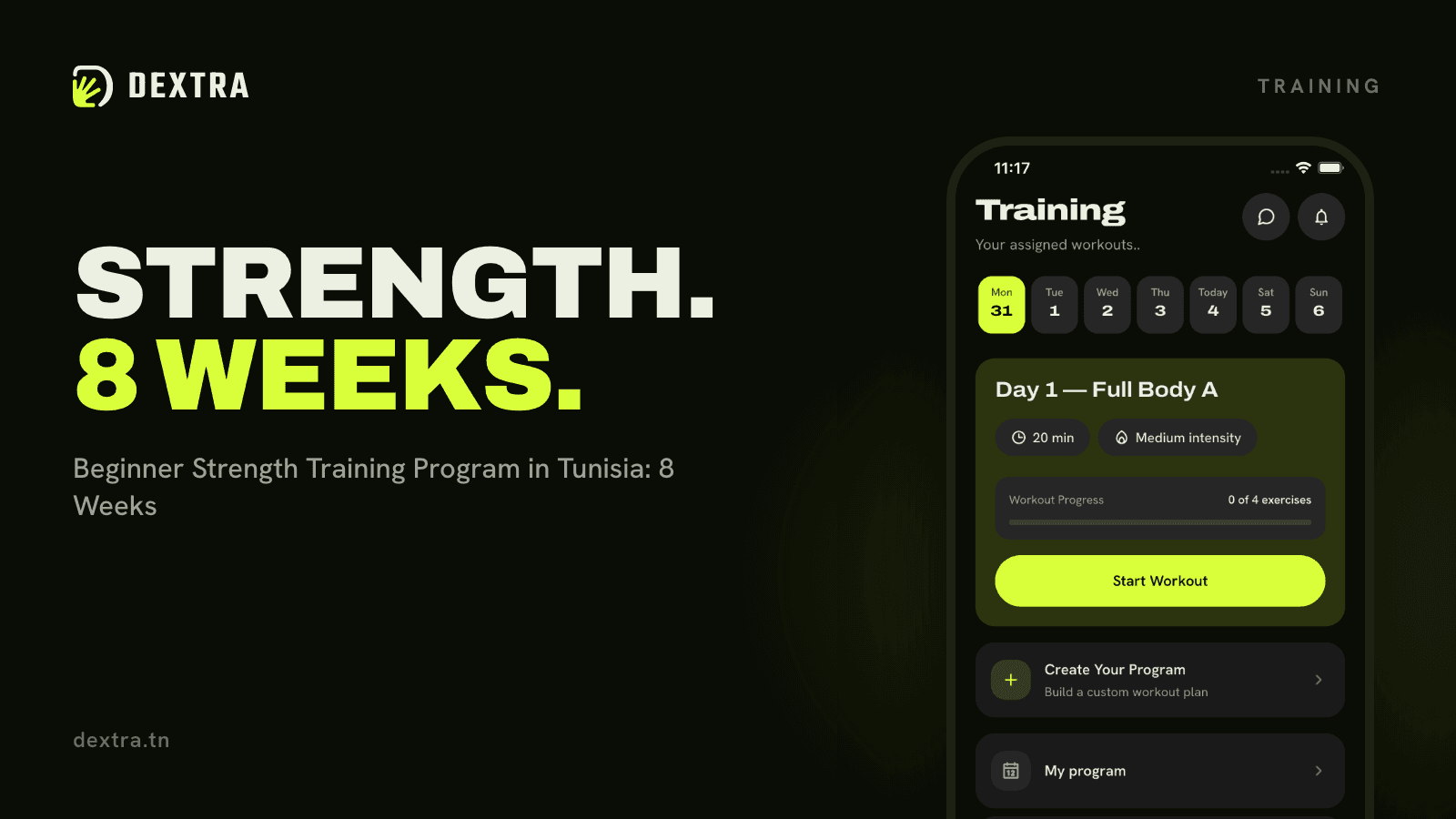
Starting strength training is one of the best decisions you can make for your health, energy and confidence. But beginners quickly run into a problem: contradictory advice, programs copied from advanced athletes and promises of results in two weeks. This guide offers the opposite: a simple, progressive and realistic 8-week plan, adapted to life in Tunisia, whether you train at home without equipment or in a gym.
If you have a health condition, an old injury or any doubt, consult a doctor before starting a training program.
The three principles that matter most
Before talking about exercises, you need to understand why a program works. Three principles are enough for a beginner.
Technique first. A well-executed bodyweight squat is worth more than a heavy squat done badly. The first weeks are for learning the movements, feeling the muscles work and protecting your joints. The load will follow naturally.
Progressive overload. The body adapts to what you ask of it. To progress, you need to increase the difficulty very slightly over the weeks: one more repetition, one more set, a little more weight or a more demanding variation. Step by step, never abruptly.
Recovery. Muscle is built during rest, not during the session. A beginner who trains three times a week with a rest day between sessions progresses better than one who exhausts themselves six days out of seven. Sleep counts as much as training.
Why 3 full-body sessions a week
For a beginner, a full-body program (the whole body in every session) three times a week is the most effective formula and the easiest to stick to. Each muscle group is trained three times a week, which speeds up technical learning, and the rhythm leaves a full day of recovery between two sessions.
An example schedule: Monday, Wednesday, Friday, or Saturday, Monday, Thursday. What matters is keeping at least one rest day between two workouts and choosing time slots you can genuinely respect, even during busy periods of work or study.
The warm-up: 8 non-negotiable minutes
Never skip the warm-up, especially at the start. It prepares the joints, raises muscle temperature and reduces the risk of injury.
- 1.3 minutes of light cardio activation: brisk walking, high knees on the spot, skipping rope or cycling.
- 2.3 minutes of mobility: shoulder rotations, hip circles, dynamic lunges, torso rotations.
- 3.2 minutes of specific movements: one light set of each exercise of the day, with bodyweight or a very light load.
Weeks 1 to 4: learning the movements
The goal of this first block: master the technique and build the habit. Use 2 to 3 sets of 8 to 12 repetitions per exercise, with 60 to 90 seconds of rest between sets. The difficulty should be moderate: you should finish each set feeling you could have done 2 or 3 more repetitions.
Each session contains the same six basic movements. For each one, a home variation without equipment and a gym variation.
- Squat: at home, bodyweight squat or chair squat; at the gym, goblet squat with a kettlebell or dumbbell.
- Horizontal push: at home, knee push-ups or incline push-ups with hands on a table; at the gym, dumbbell bench press.
- Pull: at home, towel row around a sturdy post or inverted row under a solid table; at the gym, seated cable row or lat pulldown.
- Lunges or hips: at home, reverse lunges or glute bridge; at the gym, leg press or dumbbell lunges.
- Vertical push: at home, pike push-ups (hips raised); at the gym, seated dumbbell shoulder press.
- Core: plank for 20 to 40 seconds, 2 to 3 sets, at home or at the gym.
Finish with 5 minutes of slow walking and a few gentle stretches.
Weeks 5 to 8: building strength
Once the movements are mastered, move to 3 sets of 8 to 12 repetitions on all exercises, with the same rest periods. This is the time to apply progressive overload: increase the difficulty of a variation or add a little load when 12 repetitions become easy.
The movements evolve slightly to stay challenging.
- Squat: at home, squat with a 2-second pause at the bottom or assisted Bulgarian split squat; at the gym, heavier goblet squat or barbell squat with a light load.
- Horizontal push: at home, classic push-ups on the floor; at the gym, dumbbell or barbell bench press.
- Pull: at home, inverted row with feet further away; at the gym, single-arm dumbbell row or heavier lat pulldown.
- Hips: at home, single-leg glute bridge; at the gym, Romanian deadlift with dumbbells, moderate load.
- Vertical push: at home, pike push-ups with feet elevated; at the gym, dumbbell shoulder press.
- Core: plank for 30 to 45 seconds, then side plank for 20 to 30 seconds on each side.
How to progress without getting injured
The beginner's rule is simple: change only one variable at a time. Here is the method.
- 1.When you complete 12 clean repetitions on all sets of an exercise, increase the load slightly (1 to 2.5 kg for dumbbells) or move to the next variation.
- 2.Then go back to 8 repetitions and work your way up to 12 over the following sessions.
- 3.If your technique breaks down, reduce the load. A bad repetition brings nothing.
- 4.Write down every session: exercise, load, repetitions. This logbook is your best ally.
One week in four, if you feel tired, deliberately reduce the volume by a third. This kind of lighter week is part of a good program.
Classic beginner mistakes
- Wanting to go too fast: loading too heavy in week two, adding sessions, training despite intense soreness.
- Copying advanced programs: five days a week, one muscle per day, dozens of sets. Unsuitable and often demotivating for a beginner.
- Neglecting the lower body and back: legs and pulling movements are the foundation of a balanced physique and good posture.
- Skipping the warm-up: the leading cause of small, avoidable injuries.
- Changing programs every two weeks: consistency over 8 weeks beats novelty.
- Comparing yourself to others: every body has its own pace. Compare yourself to yourself, week after week.
Nutrition and hydration for beginners in Tunisia
You do not need a complicated diet to start. A few basics are enough.
Protein at every meal. It allows muscles to repair and grow. Affordable, accessible sources in Tunisia are plentiful: eggs, chicken, sardines, tuna, fish, lentils, chickpeas, beans, milk, fromage blanc, yogurt. Aim for one portion of protein at each main meal.
Quality carbohydrates for energy. Wholegrain bread, couscous, rice, potatoes, fruit and vegetables provide the fuel your sessions need. Do not cut them out, especially at the beginning.
Hydration in the Tunisian heat. Between May and October, water losses are significant. Drink regularly throughout the day, bring a bottle to every session and prefer training early in the morning or in the evening when temperatures drop. A pinch of salt in your meals helps compensate for sweat losses on very hot days.
Sleep. Seven to eight hours of sleep per night support recovery and training energy. It is a free lever that is often neglected.
When to ask a coach
This program is enough to get started well. But guidance becomes valuable in certain situations: you are not sure about your technique, you feel joint pain, you plateau after several weeks, you have a specific goal (weight loss, muscle gain, preparation for a sport) or you simply lack the motivation to keep going alone.
A certified coach corrects your movements, adapts the loads to your real level, adjusts your nutrition and gives you a weekly framework. If you want this kind of follow-up without travelling, Dextra is a Tunisian online fitness coaching app, free on iOS and Android, with certified coaches based in Tunisia, a personalised program, nutrition tracking and in-app messaging. There is a free plan, and paid plans at 149 TND and 299 TND per month for full weekly follow-up, with equipment-free home workouts and an interface in French, Arabic and English.
Eight weeks, three sessions, six movements. That is all you need to lay solid foundations. Focus on technique, progress slowly, sleep enough, eat protein and drink water. In two months you will be stronger, more comfortable in your movements and, above all, you will have built a habit that can last a lifetime.
Related guides
Ready to start your journey?
Download Dextra and get a personalized plan built for your goals.
Download Dextra