Fitness Coaching App in Tunisia: What to Check First
Human coach or videos, Flouci or D17 payment, prices in TND, Arabic RTL interface: the 12-point checklist to run before downloading a fitness app in Tunisia.
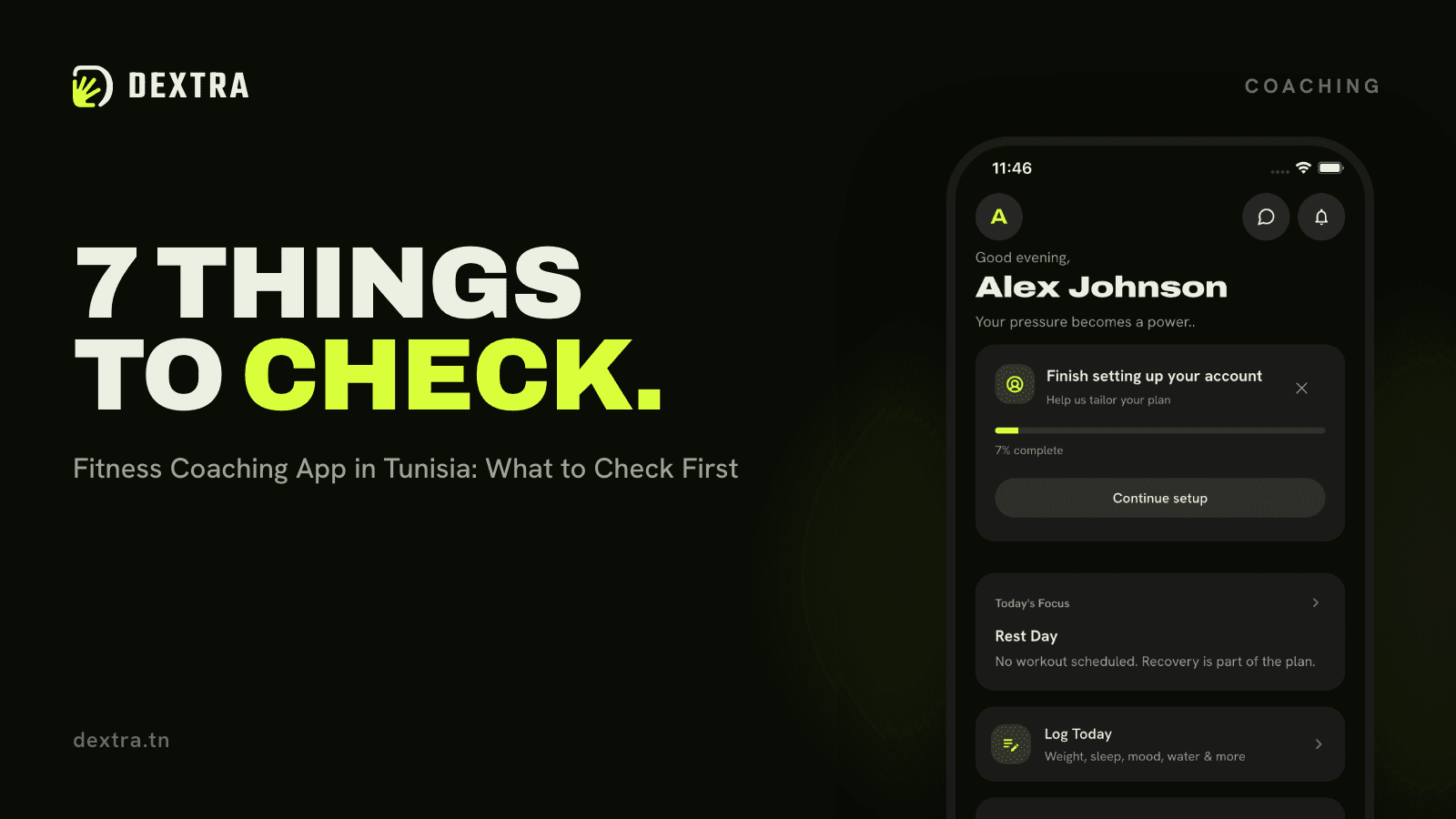
Choosing a fitness app in Tunisia is no longer a matter of scarcity: the iOS and Android stores offer dozens of them, with very similar promises. The real difficulty is telling a fitness coaching app that will actually support you apart from a plain video collection dressed up as a subscription. This guide gives you the concrete points to check before you download, from the type of supervision to the payment method, through the interface language and the clarity of prices in dinars.
The goal is not to name a perfect app. It is to help you ask the right questions, spot the grey areas and test before you pay.
Fitness coaching app: human coach or video library?
This is the first distinction to make, and it changes everything. Many apps present themselves as "coaching" when they actually offer a library of pre-recorded sessions sorted by goal or duration. That format has its advantages: it is inexpensive and available immediately. But nobody watches your technique, nobody adjusts the load when you plateau, and nobody answers when you have a question.
An app with a human coach works differently. A real person reads your answers to the intake questionnaire, builds your programme, corrects it week after week and talks with you. Before downloading, look for clear answers to these questions:
- Is the coach an identifiable person with a verifiable certification?
- Where are they based? A coach who knows the pace of life, the schedules and the eating habits in Tunisia will understand your constraints better.
- How many clients do they follow at the same time? Real follow-up takes time.
- Is the "coaching" included in the price or sold as a paid extra?
If the app stays vague about who will support you, treat it as a video library and evaluate it as such.
A programme and nutrition that are truly personalised
The word "personalised" is used everywhere. To know whether it is deserved, look at what the app asks you at the start. A three-question form (goal, level, frequency) produces at best a generic programme picked from a handful of templates. A serious initial assessment cares about your available equipment, your past injuries, your schedule, your food preferences, your grocery budget and what you hate doing.
On the nutrition side, be wary of fixed plans sent as a PDF. A good app offers nutrition follow-up that evolves with you, takes into account the foods actually found here, and adapts to Ramadan, family meals or busy periods. The programme must be able to change along the way: if your timetable flips, your plan should follow.
Follow-up, messaging and coach responsiveness
A programme, even an excellent one, is only worth the follow-up that comes with it. Check three things.
First, the frequency of follow-up. A weekly check-in is a good benchmark: frequent enough to correct quickly, spaced enough to let the body do its work. Second, the channel. In-app messaging keeps the history of your exchanges in the same place as your sessions and measurements, which is more reliable than a conversation scattered across several messaging apps. Third, the stated response times. Nobody needs an answer in five minutes, but you should know what to expect.
Test the messaging during the free period: ask a real question and watch the quality of the answer, not only its speed.
Language, Arabic and RTL interface
A point too often overlooked. An app you use every day must speak your language, and in Tunisia that often means being able to switch between French and Arabic depending on context, or even English for some technical terms.
For Arabic, translation alone is not enough. Check that the interface really switches to RTL (right-to-left) mode: text alignment, button order, direction of lists and progress bars. An app that displays Arabic text inside a layout designed for French quickly becomes tiring to use. Also check that the coach themselves can communicate in the language you are most comfortable with when talking about your body and your habits.
Local payment, prices in dinars and cancellation
This is often where the decision is made. Many international apps only accept foreign bank cards or payment systems that are hard to access from Tunisia. Before you get attached to an app, check the payment methods on offer: Flouci, D17, Click to Pay or a Tunisian bank card are the options that avoid blocked payments and conversion fees.
Then look at the price. A rate displayed in Tunisian dinars is a sign of seriousness: you know exactly what you will pay each month, with no surprise tied to the exchange rate. Dextra, for example, lists its paid plans at 149 TND and 299 TND per month, alongside a free plan.
Finally, read the cancellation terms before you pay, not after. The points to clear up:
- Does the subscription renew automatically?
- Can you cancel from within the app, in a few taps?
- What happens to your data and history after cancellation?
- Is there a minimum commitment?
An app that makes cancelling difficult is telling you something about how much confidence it has in its own service.
Daily use: home, offline, progress and data
Four practical points deserve a quick check.
Home training without equipment. Not everyone has access to a gym, and schedules change. A good app offers complete sessions you can do in a living room with your body weight, and knows how to adapt a planned gym session when you do not make it there.
Offline mode. The connection is not always stable everywhere. Check that you can view today's session without network and record your performance later.
Progress tracking. Beyond the number on the scale, look for varied measures: weights lifted, repetitions, waist circumference, comparison photos, how your energy and sleep feel. A readable dashboard over several weeks motivates more than an isolated figure.
Data privacy. A fitness app collects sensitive information: weight, photos, habits, sometimes location. Read the privacy policy, check that you can delete your account and your data, and be wary of apps that request permissions unrelated to training.
The 12-point checklist before you download
- 1.An identifiable, certified human coach, or a video library that is clearly presented as one.
- 2.A detailed initial assessment, not three questions.
- 3.A programme that evolves week after week.
- 4.Nutrition follow-up adapted to local foods and habits.
- 5.A regular check-in, ideally weekly.
- 6.In-app messaging with stated response times.
- 7.An interface in French and Arabic, with a true RTL mode.
- 8.Local payment methods: Flouci, D17, Click to Pay, bank card.
- 9.Prices displayed in dinars and readable cancellation terms.
- 10.Home sessions without equipment and offline access.
- 11.Progress tracking that is not limited to weight.
- 12.A free plan to test before paying, and a clear privacy policy.
An app that ticks ten points out of twelve deserves your attention. An app that stays vague about payment, cancellation or the coach's identity deserves a second look.
Getting results with any app
The best app in the world will not do the work for you. Three habits make the difference, whichever app you choose.
Consistency before intensity. Three sessions a week kept up for six months are worth far more than six sessions a week abandoned after three. Choose a volume you can sustain in your worst weeks, not your best ones.
An honest log. Write down what you actually did and ate, not what you wished you had done. A coach can only adjust what they see; embellished data produces an ill-fitting programme.
Communication with the coach. Say when a session is too hard, when a meal does not suit you, when your week fell apart. That is precisely what you are paying for when you choose human support over a video.
If you want to apply this checklist to a concrete example, Dextra is a Tunisian online fitness coaching app, free to download on iOS and Android, with certified coaches based in Tunisia, an interface in French, Arabic and English, and local payment methods. You will find all the details at dextra.tn. Whatever you decide, take the time to test before committing: it is the one check that never lies.
Related guides
Ready to start your journey?
Download Dextra and get a personalized plan built for your goals.
Download Dextra