Online Fitness Coach in Tunisia: The Complete 2026 Guide
How online fitness coaching works in Tunisia, who it suits, what it costs per month and how to choose a serious certified coach: the complete guide to start.
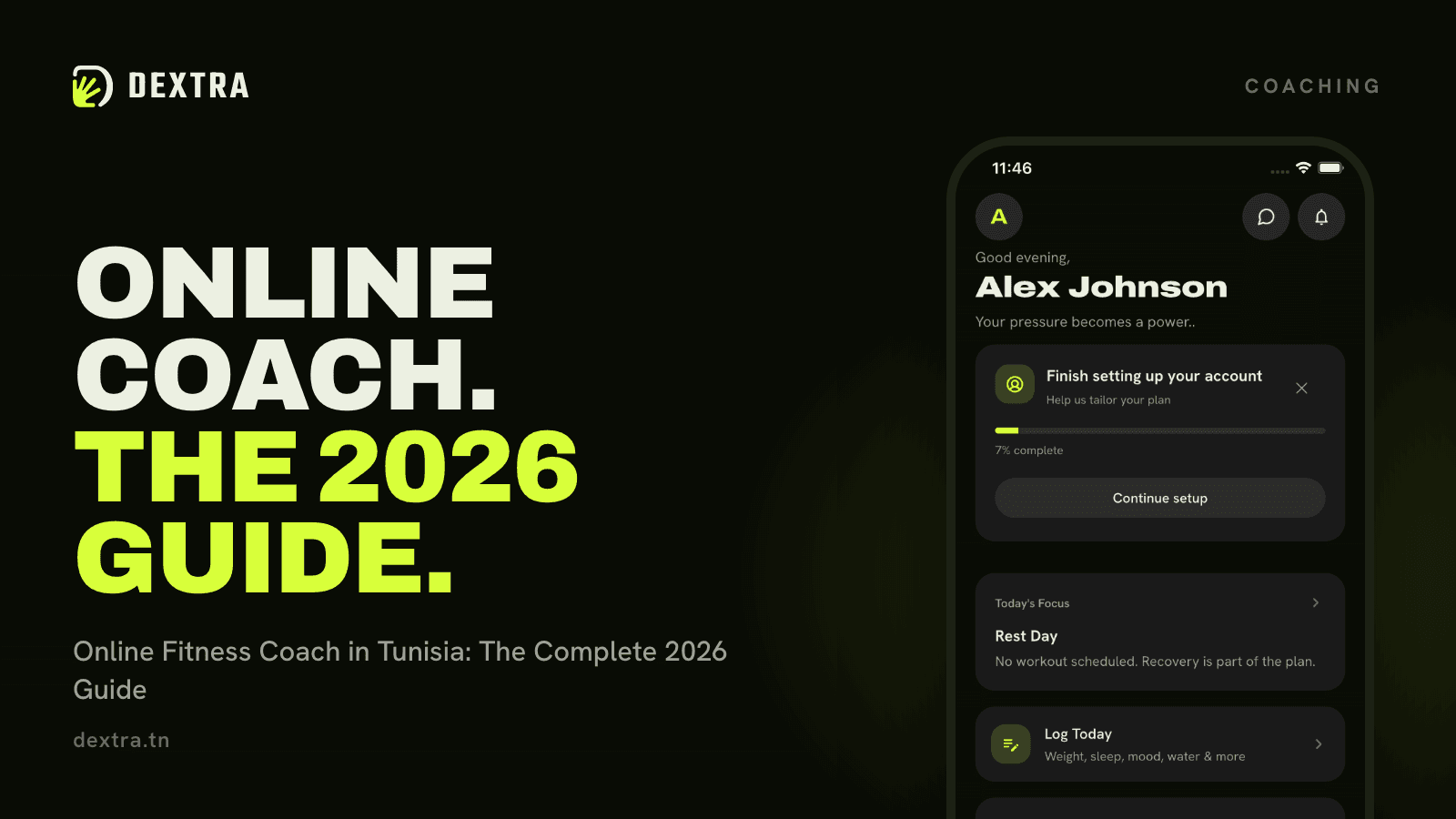
Online fitness coaching has settled into Tunisia quietly. Not long ago, being followed by a coach meant paying for a gym in Tunis or Sousse, finding a slot after work and hoping the coach was available. Today, an online fitness coach in Tunisia follows you from your phone, wherever you live, from La Marsa to Gabès. This guide explains concretely how online coaching in Tunisia works, who it suits, what it costs and how to avoid the traps.
What is online fitness coaching?
The principle is simple: a qualified coach builds your training programme and, usually, your nutrition guidelines, then follows you remotely. You train on your own, at home, at the gym or outdoors, and the coach adjusts the plan every week based on your feedback.
This is not a YouTube video or an app that hands the same programme to everyone. The difference is the human behind it: someone who knows your history, your schedule, your fragile knee and your goal, and who adapts.
How it works concretely in Tunisia
The typical journey looks like this:
- 1.An initial assessment. You fill in a detailed questionnaire: goal, level, past injuries, available equipment, how many sessions you can realistically do per week, eating habits. A serious coach also takes time for a direct conversation, by message or call.
- 2.A personalised programme. The coach builds your sessions in the app: exercises, sets, reps, rest times, with demonstration videos. If you have no equipment, they build a bodyweight programme or work with whatever you have at home.
- 3.Nutrition follow-up. Not an imposed diet, but reference points: protein intake, meal structure, how to handle outings and family meals. Sunday couscous is not banned, it is built in.
- 4.Weekly follow-up. Every week you send your feedback: sessions done, how you felt, weight, measurements, sometimes photos. The coach analyses and adjusts load, volume or nutrition.
- 5.Messaging. Between two reviews, you ask your questions in the app. An unusual pain, a doubt about an exercise, a business trip to Sfax that breaks the routine: the coach answers and adapts.
With Dextra, all of this happens in one app, in French, Arabic or English, with certified coaches based in Tunisia. You pay with the methods you already use: Flouci, D17, Click to Pay or bank card.
Who is online coaching in Tunisia for?
Online coaching suits certain profiles particularly well:
- Employees with packed schedules. Between the commute, the office and family, fitting in a gym hour at 6 pm is a feat. A programme you do at home at 6 am or 9 pm removes that constraint.
- Beginners intimidated by the gym. Many people never dare to walk through a gym door. Starting at home, with a coach who explains every movement, is a gentler entry point.
- People in mid-sized towns or rural areas. Qualified coaches are concentrated in Greater Tunis, Sousse and Sfax. Online, someone in Bizerte, Kairouan or Tataouine gets the same level of support.
- Women who prefer to train at home. For comfort, privacy or logistics, training at home with serious follow-up is a real alternative.
- People who have already tried everything alone. You know the exercises, but you cannot stick with it. Weekly follow-up changes everything: someone is waiting for your feedback.
That said, online coaching is not ideal for everyone. If you have a health condition that requires direct supervision, or if you are a competitive athlete who needs real-time technical corrections on complex lifts, in-person coaching remains preferable. And whenever you have a doubt about your health, a doctor's opinion comes before any programme.
Online coaching or the gym: the real differences
The question comes up constantly, and the honest answer is: it depends on you. Here are the points that actually matter.
The programme. At the gym, unless you pay a personal trainer, you often follow a generic programme posted on the wall or found online. Online, the programme is built for you and evolves every week.
Flexibility. An online programme is done when you want, where you want. In summer, when Tunis climbs past 38 degrees, you can train early at home rather than crossing the city. During Ramadan, your coach moves sessions to after iftar or before suhoor and lightens the load without breaking your progress.
Equipment. The gym has the advantage of heavy equipment. But to lose fat, get back in shape or build a solid muscular base, bodyweight, resistance bands and a pair of dumbbells are plenty for months.
How much does an online fitness coach cost in Tunisia?
Prices vary a lot depending on the level of follow-up. A simple programme sent as a PDF, with no follow-up, should not cost much, but it does not deliver big results either. Real coaching, with a personalised programme, weekly adjustments and messaging, is a monthly investment comparable to a decent gym membership, and often less than an in-person personal trainer.
As a concrete reference, the Dextra app is free to download on iOS and Android, with a free plan to get started. Paid coaching plans start at 149 TND per month for the VIP plan and 299 TND per month for the Premium plan.
When comparing, do not look only at the price. Ask what it includes: is the programme truly personalised? Is follow-up weekly? Can you message the coach between reviews? Is nutrition included? Cheap coaching with no follow-up ends up costing more than slightly pricier coaching that actually gets you results.
How to choose a serious coach
This is the most important point in this guide. Online coaching has opened the door to many competent people, and also to a few who sell copy-pasted programmes after three months of lifting. Here is what to check.
- Certifications. A serious coach has recognised training: a state diploma, a degree in sports science or an international coaching certification. They show it without being pushed. Be wary of anyone whose only diploma is their abs.
- The initial assessment. If the coach sends you a programme ten minutes after your first message, without asking about injuries, level or schedule, that programme is not personalised.
- Follow-up frequency. Ask precisely: how often is the programme adjusted? How quickly do you answer messages? Weekly follow-up is the minimum standard for coaching worthy of the name.
- Transparency about results. An honest coach does not promise ten kilos in a month. They talk about a reasonable pace, consistency and what you will have to do on your side.
- Nutrition. The coach should give realistic reference points adapted to Tunisian cooking, not a chicken-and-broccoli plan imported from elsewhere. And they should never sell miracle products.
The most common mistakes
After supporting many people, the same traps keep coming back.
Wanting to change everything at once. Five sessions a week, zero sugar, ten thousand steps a day. Three weeks later, it all collapses. A good coach starts with what you can sustain, often three 40-minute sessions, and builds up gradually.
Not sending your feedback. Online coaching runs on the information you provide. If you send nothing, the coach cannot adjust anything. Five minutes on Sunday is enough.
Changing programmes every two weeks. Results come from repetition and progression, not novelty. Let a programme work for at least six to eight weeks.
Neglecting sleep and hydration. Especially in summer. A body that sleeps five hours and drinks one litre of water a day does not progress, whatever the programme.
How to start this week
You do not need to wait for the first of the month, the end of Ramadan or September. Here is a simple plan for the next seven days.
- 1.Set a clear, measurable goal. Not "get fit", but "three sessions a week for three months" or "lose waist circumference by December".
- 2.Take stock of your reality. How many sessions a week, at what time, with what equipment? Be honest: three sessions you actually do beat five you dream about.
- 3.Choose a coach using the criteria above. Take time to talk before committing.
- 4.Block your slots in your calendar like work meetings. Early morning before the heat is often the best time in Tunisia.
- 5.Do your first session without chasing perfection. The goal of week 1 is to start, not to impress.
The World Health Organization recommends at least 150 minutes of moderate physical activity per week for adults. Three 50-minute sessions already get you there. It is not out of reach, even with a demanding job and a family.
If you want to try online coaching with a certified coach based in Tunisia, the Dextra app is free on iOS and Android, and the free plan lets you see how it works before committing. The best programme is still the one you actually start.
Related guides
Ready to start your journey?
Download Dextra and get a personalized plan built for your goals.
Download Dextra